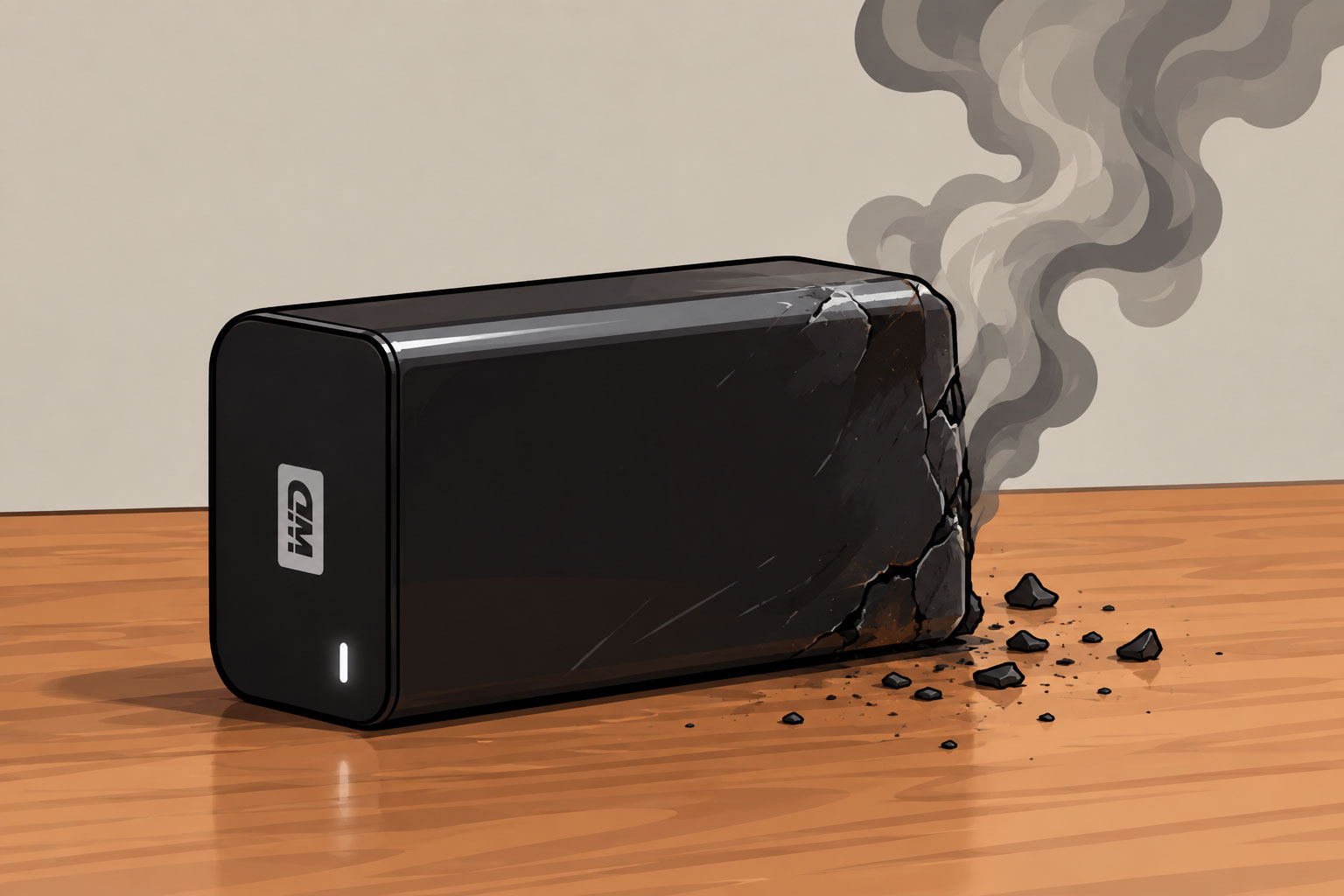
I knocked it over.
Just a simple little desktop Western Digital 14TB external hard drive. A completely unassuming black plastic box. But that small accident ended up making me completely reevaluate the way I was dealing with my photography. It’s probably the simplest way of explaining how I ended up spending a week trying to recover over two decades of photographs.
At first I wasn’t particularly worried. The drive had simply unmounted from the computer. No drama. I assumed I could restart, reconnect the drive and carry on.
Except then I heard the noise.
When I tried to copy some files, the messages started appearing.
Unable to read.
Damaged files.
Problems with drive L.
And that sickly feeling of oh shit, what have I done? started to creep in.
Surely it can’t be that easy to lose everything?
Apparently it is!
The drive had been knocked onto its side while I was leaning over to adjust my monitor. I was loading a file at the time and it appears the heads and platters had been damaged. One data recovery company told me that because it was a helium drive, the situation was particularly difficult, and effectively told me that the data was lost. The next gave me a quote of more than £1,500.
That was quite a good incentive to have a go myself. I’m not sure whether that was particularly sensible, but I started looking into what I could do and eventually began the recovery. From that point, I spent the next week doing little else.
It was painfully slow. I mean slow. The computer ran 24 hours a day for a full week.
With very little knowledge of data recovery in the first place, and certainly no experience about things like CMD, PowerShell prompts or Linux, I had to teach myself as I went along. I’d try one technique. It would get so far and then fail, so I’d try something else. Sometimes it worked, sometimes it didn’t. Then I’d start again. But as the recovery went on, every file that couldn’t be recovered became more important than the last one. At first, if a few files were missing, I’d think, that’s annoying. Then it became, hang on, I want that one back.
Fortunately, over the years I’d accumulated various smaller drives. Some had old, half-hearted attempts at backing things up on them. They weren’t anything like a proper backup system, but they did contain copies of some of the older work. As the recovery progressed, those copies gave me another way of finding files that the damaged drive couldn’t recover.
I became almost obsessed and took it as a challenge. In the end I had to admit defeat — at least for now. But I gave it a good go and, out of the nearly full 14TB drive, about 75GB remained unrecovered. In the context of 14TB, that’s not a huge amount. And compared to what the advice from the data recovery people was, it’s a fairly good win.
One big slap in the face was just how much of a mess I’d allowed my photographic collection to become. There were files here, there and everywhere. Old drives tucked away, different versions of photographs in different places and half-finished attempts at organising things. Some work was duplicated, some wasn’t. Some things had been backed up at some point, some clearly hadn’t.
I had accumulated data, but what a state of affairs it was in. Trying to work out what had been recovered and what hadn’t made me realise that this wasn’t how I wanted to carry on. There were photographs on those drives that I hadn’t looked at for years. As each image came up on the screen, I realised that I actually remembered taking almost all of them. Sometimes I couldn’t remember the photograph at all until I saw it, but then a little spark. A place, a day, something that happened while I was taking it.
Isn’t that one of the wonderful things about photography?
It’s almost like having a backup system for your own memory. The photograph sits there quietly for years, and then suddenly gives you something back that you’d forgotten. It made me realise just how important this collection actually is to me. These weren’t just files taking up space on a hard drive. They were bits of my own memory. Old shoots, trips and experiments that had been sitting there for years, waiting to be rediscovered.
So while I was recovering everything, I started making decisions about what actually needed to be kept. It gave me a very good opportunity to cull. There were duplicates, old versions and photographs I’d kept simply because I’d never got around to deciding whether they were worth keeping.
Storage had become cheap enough that I’d stopped making those decisions. I could just buy another drive. But that doesn’t really help.
And Lightroom wasn’t helping. My old catalogue had evolved over years rather than being deliberately designed. The folder structure had become complicated, the keywords had multiplied and I wasn’t always entirely sure why I’d done things the way I had.
So I decided to wipe the whole thing and start again.
Everything.
It was actually quite liberating. Instead of trying to preserve a complicated system simply because I’d spent years building it, I could ask a much simpler question: What do I actually need? The answer wasn’t very much.
I wanted to know where a photograph was taken, be able to find it again and have the basic information about it consistent. I wanted keywording that actually worked, rather than a huge hierarchy that looked clever but became so complicated that I stopped using it properly. The same went for the folder structure. The more decisions I have to make every time I import a photograph, the more likely I am to make a mistake. And I know what I’m like.
If I make the system too complicated, I’ll start overthinking it. Then I’ll change it, forget what I changed and eventually end up with three different ways of doing the same thing. So the new system had to be simple. And, wherever possible, automatic. The less I have to think about the mechanics, the more I can concentrate on the photographs. By the time I’d finished recovering, culling and reorganising, I’d effectively rebuilt the whole system from scratch. Now was the best time to start thinking much more seriously about the storage system itself.
Before this, storage had basically been something I dealt with when I ran out of it. You buy a bigger drive, move some stuff onto it, buy another one when that gets full and occasionally think, I really ought to back all this up properly. I’d accumulated plenty of drives over the years, but that wasn’t the same thing as having a backup system. Some of those smaller drives had simply been copied to the main 14TB drive at some point. So if the 14TB drive failed, I might have another copy of some of the files, but there was no proper system behind it. And much of the collection still existed only on that one drive. I’d just never really thought about what would happen if something went wrong.
Until something went wrong.
Now I have multiple large drives with copies of the data on them. Those drives are backed up to a Drobo RAID system, and I’m using software to keep the various copies synchronised. Eventually, for the photographs that really matter, I’ll also put copies onto Blu-ray and keep those off-site. It sounds like a lot. And it is. But after spending a week trying to pull photographs off a damaged drive, I don’t particularly care anymore. I’d rather have too many copies than have to do that again.
The other thing that changed was what I considered important.
Initially, all of this was about protecting the photographs I’d already taken. Then I started thinking about the photographs I haven’t taken yet. I’m spending a lot of time and money travelling to places, finding locations, waiting for the right light and making photographs. That slower way of working has become an important part of how I approach my photography. Some of them might be good, some won’t, but I don’t want the result of all that effort to ultimately depend on whether one piece of hardware decides to behave itself.
And perhaps that’s the slightly unexpected thing that came out of the whole experience. I started out trying to recover some photographs and ended up rebuilding the way I deal with all of them. The photographs were culled, the catalogue was wiped and rebuilt, the keywording and folder structure were simplified, and the backup system finally got the attention it should have had in the first place.
I’d spent years thinking about the photographs, where to store them, how to organise them and how to process them. I just hadn’t given enough thought to what would happen if I lost them. Now I have.
The irony is that I used to think of storage and backup as one of the boring parts of digital photography. The camera, the lenses and the travel are exciting. Buying another hard drive because you’ve run out of space isn’t. But having spent a week watching a damaged drive slowly give up its contents, I’m quite happy for the boring bit to be completely over the top.
I’d much rather spend the money on hard drives, Blu-ray discs and storage than another £1,500 trying to get them back.
More writing on photography, travel and process can be found in the Journal.